
Reykjavik's underwater forests
Not far away from our harbour, we can find an amazing garden right under the surface. Just as in land, in this underwater garden we can find different species of different sizes, colours, textures... One group that stands out from the rest is the kelp.
Kelp is a general term that we often use to talk about different species of seaweed that belong to the Order Laminariales. However, sometimes people use this word to talk about other species from other families of brown algae that can also form canopies and provide similar functions. This time, we are going to use this word in a broader sense to learn about the trees in these gardens, which will be our beautiful kelp.

Kelps can be found on rocky reefs in lower intertidal and shallow subtidal zones throughout temperate and subpolar regions of the world. This means that when you go back home, if you pay attention, you may see species that might resemble those that we have here. Kelps can even be found in the Mediterranean Sea! However, since they generally prefer cold water, kelps in the Mediterranean are found at greater depths where the water is colder. Thanks to the high transparency of mediterranean water, sunlight can reach deeper regions which allows them to grow up as deep as 100 m.
Life cycle

Kelps from the order Laminariales have a very interesting life cycle. These kelps have an alternation of generations. This means that we have one generation in which kelps are microscopic filamentous algae called gametophytes. Gametophytes can be either male or female, just like us, and are in charge for producing and releasing gametes. After fertilization, a zygote is form and grows into a big and beautiful sporophyte which is what we see when we look at the water. This sporophyte will produce male and female spores which will turn into male and female gametophytes.

Some species from the order Fucales, which can be also referred to as kelp, have a different life cycle that resembles ours. This is the case of the old and wise Ascophyllum nodosum (knotted kelp) which can live up to 100 years! Depending on the species, male and female can be found in different individuals or in the same individual. In the case of our beautiful Ascophyllum we have male and female Ascophyllum. Male and female will release the gametes into the water where fertilization takes place. Then, the zygote will settle onto a rock and grow into a shiny olive green Ascophyllum. Here, we don't have a microscopic life stage.
Where can we see them?

In the marine environment, especially in the intertidal, we need to consider zonation, which is the natural arrangement of organisms across a gradient. In the intertidal, the higher a species is found, the more it needs to endure physical stressors: UV radiation, dryness, freshwater input, etc. On the other hand, the deeper you go and the closer you get to the subtidal regions, the more competition there is for space and resources: nutrient availability, space availability, herbivory, etc. Taking this into account, we can see different species in different areas.
Let's start within the harbour. On the walls of the harbour we can clearly see this zonation pattern. At the very top of the wall, we can see Fucus spiralis, which is the best at tolerating desiccation. Right underneath, we have Ascophyllum nodosum which dominates the middle intertidal zone and can be found down into the upper sublittoral. Finally, in the subtidal we can find the “proper” kelps, the seaweed from the order Laminariales. Here in the harbour we can find 2 species: Alaria esculenta and Saccharina latissima. Since these species are found in the subtidal region, it will be difficult for you to see them during high tide. But here is the trick, the floating docks move up and down with the tides, so there is always an area close to the surface which is remains submerged. This is where you want to look to find this beautiful seaweed.


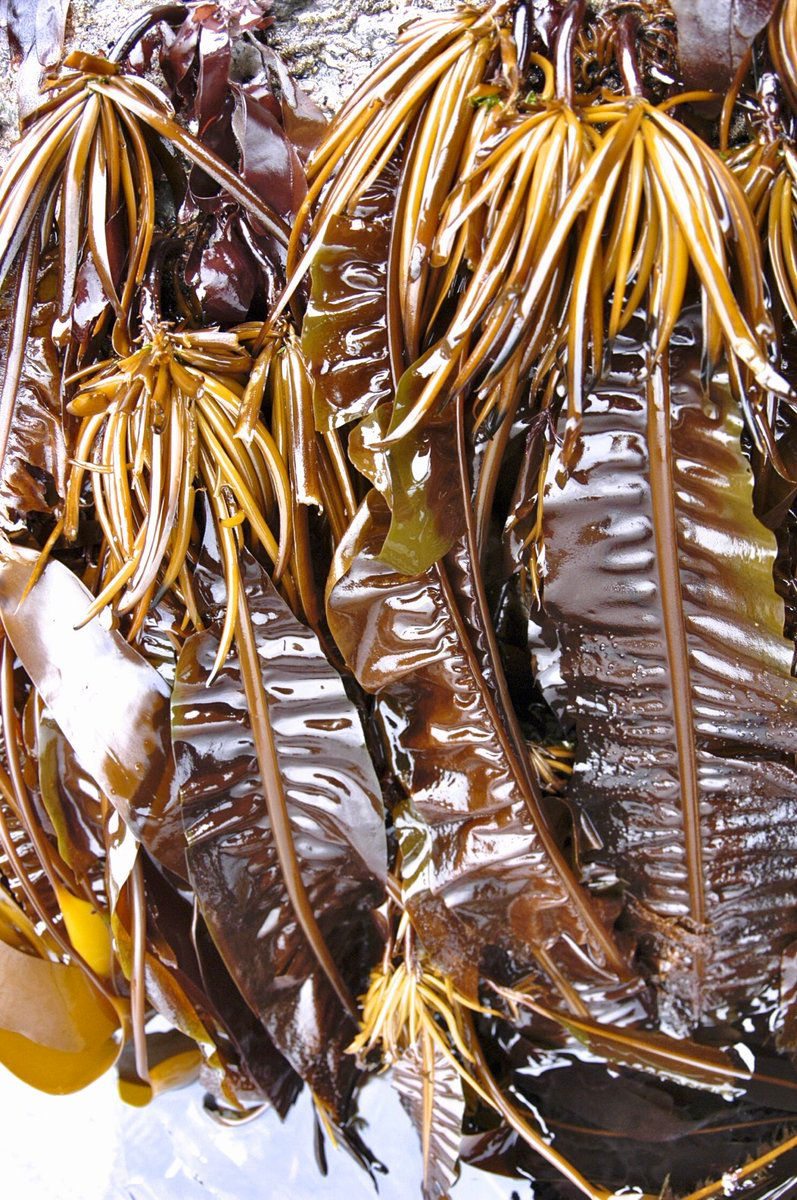

When we leave the harbour and go to the islands where the puffins are nesting, we can find the beautiful and elegant Laminaria. Species of this genus prefer more pristine waters, so harbours are not ideal for them. However, they can thrive in the rocky substrates of the sheltered areas of the bay. There, we can find Laminaria digitata growing in the upper subtidal zone and Laminaria hyperborea at higher depths. Laminaria sp. has blades that resemble a hand with a long stem (stipe) and roots (holdfast) that help them attach to the rocks. They look very similar to the trees that we find on land. If our puffin tours take place during low tide and the water is calm, it is worth taking a look underwater and checking out these massive trees growing underwater which can reach 5 m height.
Even among these species, we can find zonation. L. hyperborea and L. digitata are difficult to differentiate but luckily for us they live in different places. L. digitata is found mostly in the lower intertidal zone and very shallow subtidal waters, so at low tide, you can see the blades popping out of the water's surface. Also, the stipe (stem) of this species is oval or flattened in cross-section and flexible. On the other hand, L. hyperborea has a stipe that is perfectly circular, thicker at the base, and very rigid so it can snap when bent, like a proper tree. This species is found in the subtidal zone, so you need to look through the surface to see this species. They form dense underwater kelp forests and remain upright even underwater or when exposed. L. hyperborea can live for up to 15 to 20 years while L. digitata is an annual species, like a wildflower.

Kelps are often referred to as ecosystem engineers because they create a physical habitat that supports an entire underwater community. Therefore, it is important to protect them not only for the beauty of these underwater forests, but also for the communities of organisms living within them.
Guillermo Monescillo Aragón


Comments