
Eavesdropping in Faxaflói: Developing a hydrophone project

Updated: Apr 30
Before the start of last summer our team acquired a hydrophone; a microphone that can be used to listen to underwater sounds - and in our case specifically - the sound of the whales! Over the course of last summer, we had our first tries recording the whales and dolphins in the bay while familiarising ourselves with the hardware and software. Some trial and error later, we managed to get a few succesfull recordings of both white beaked dolphins and humpback whales! Without diving too deep into the whole range of cetacean sounds (let's save that for another blog post?), we want to share our experience so far. In this blog we'll tell you about our journey over the summer with the hydrophone and give you a behind the scenes look on what goes on in setting up a new project.
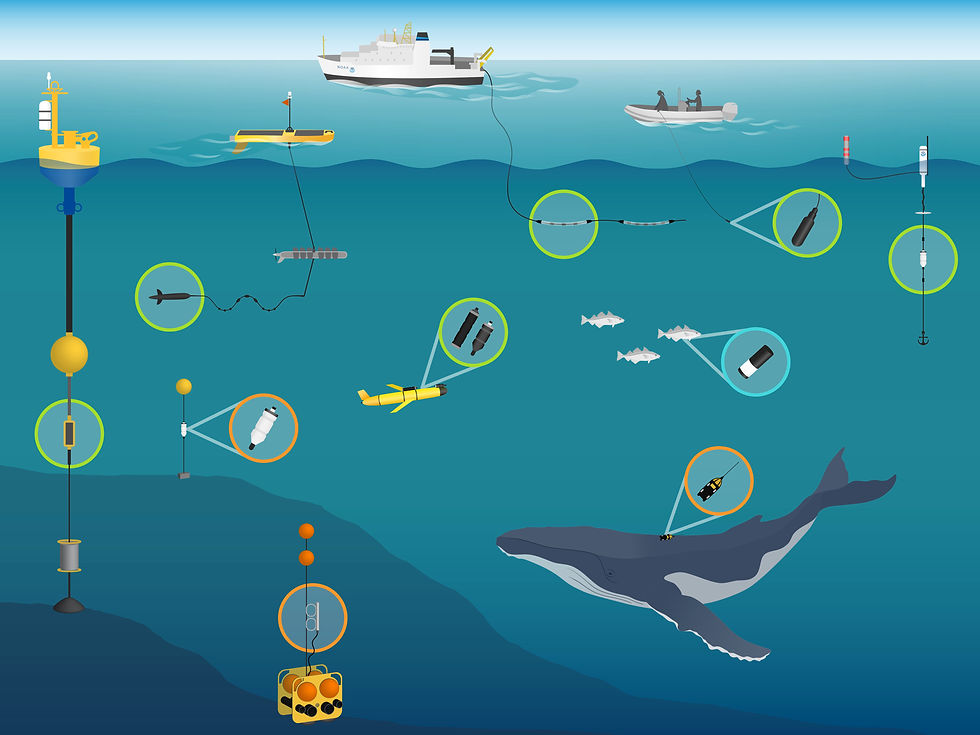
Acquiring the hardware Hydrophones are in essence quite simple recording devices and a two main types exist; active and passive. Active hydrophones send out sonar pulses and as these reflect back of the environment, it allows to create an image of the underwater surroundings. Passive hydrophones simply listen to the sounds being produced underwater, which is exactly what we need to listen to the whales! Passive hydrophones again come in 2 main categories; archival and real-time passive accoustic monitoring. Archival passive acoustic recordings can be made through hydrophones attached to the ocean floor, suspended in the water column or even attached directly to cetaceans themselves! Eventually the device can be collected and the stored data analysed. Real-time passive acoustic data collection can be done through a standalone device that immediately relays the signal, or through devices brought on board a ship. The latter was exactly what we were looking for!
We spent a lot of time looking into the hydrophones available on the market and determining which one suited our requirements best. As we planned to take our hydrophone along on RIB whale watching tours compact and easy to handle equipment was a must. We read a lot online, talked to manufacturers and even other organisations using hydrophones around iceland to get some recommendations. Eventually, we found our perfect beginner setup! A single hydrophone connected to a handheld recorder, paired with a bluetooth speaker for live playback of the recorded sounds.

Our first attemps
After figuring out what plugs in where and what button does what, we went on our first testing trip. As for the location? The end of our pier. A dip in the water and some squaky metal noises of said pier later was enough to excite our team of guides for that day. Everything worked! We did not leave it at that though, because shortly after we went on our first proper excursion to attempt a recording of an actual whale! With a few excited guides on board we sailed out, in search of humpbacks or other species! We then stumbled upon a single humpback, got ready, and threw the hydrophone in the water. A quiet suspense filled our boat as we listened carefully for any sound this whale might make. This individual was however not in a chatty mood so we had to return empty handed. We did not let this discourage us though, because some time later, we tried our luck with a large pod of white-beaked dolphins and we caught quite the ruckus! Loads of echolocalisation clicks and some squeeks left us all over the moon with excitement! This also gave us the confidence to take it along on a some tours with passengers and over the summer we attempted some more recordings here and there. We tried recording both during passenger and non-passenger trips, sometimes succesful, sometimes not. Each try was a learning moment though and so we figured out along the way which difficulties we need to take into account and which barriers to overcome.

Facing the difficulties
We quickly learned that there are quite a few factors to take into account when trying to get a good recording. First of all; the right sea conditions. Since we are working relatively close to the surface (0-15m deep), rocky seas can quickly overshadow the sound of any potential whale. The impact of the boat on the water surface as it rocks about can quickly become overly present in a recording. This means we need to look for calm seas, especially when we are trying to play a live playback of the sound during a tour. Secondly, human-made noise polution: A whale in the area can quickly draw attention of multiple whale watching vessels. An approaching or even idling engine makes a lot of noise, again making it harder to hear a whale through the noise. Achieving the perfect windless, boatless conditions can prove quite the challenge in Icelands largest bay, where many vessels sail and the winds have free play on the waves. We did however figure it was all a matter of keeping on trying and eventually we did score a few more recordings, both of humpback whales and white-beaked dolphins!
Analising the recordings
Once back on shore, it is time to plug the recording into some processing software. For this we use PAMGuard, a program specifically developed to analyse sounds of cetaceans. After loading the datafiles into the program we can visualise the sounds. Through the implementation of modules the program can help us detect whistles, moans, clicks and so forth while receiving information on the properties of these sounds. Adding in the right filters then helps to clarify and isolate the sounds of the whales and dolphins by removing other environmental sounds. The first module we use is called a spectrogram. This creates a "picture" of sound and shows how frequencies change over time. Time is displayed on the horizontal (X) axis, frequency on the vertical (Y) axis, and intensity (loudness/strength) shown by color or brightness. PAMguard also has a whistle and moan detector, it will automatically detect whistles, moans and other sounds made by the whales and indicate them on the spectrogram as it scrolls by. A whistle and moan detector can be implemented into the spectrogram aswell, where the program will indicate any whale whistles and moans it is able to detect and recognize. A second opinion is however important here to filter out false positives or find any sounds missed by the module.

Another great plugin is the click detector tool. This searches for clicks made by dolphins and indicates each one with a dot. The X-axis shows the time, while the Y-Axis shows the amplitude (dB) of each click.

Furthermore, the program allows us to filter out certain soundfrequencies to cancel out sounds from vessels in the area. It also helps to partially reduce the sound of the waves, but as these sounds consist of a wide range of frequencies and can overlap with the sound of cetaceans, this tends to be a lot less foolproof.
What we recorded so far
On trips where we attempted recordings, we managed to record white-beaked dolphins 3 times. We heard many echolocation and communicative vocalisations. Dolphins use echolocation as means to hunt food. The principle is the same as bats, where the sounds they make function as a sonar. They emit sound pulses called clicks, these clicks then reflect of the environment back to them, allowing to visualise the environment through sound and track down prey. Hunting clicks can be devided into three phases: first there are the searching clicks. These are widely spaced clicks scanning the environment. When a prey is detected, the clickrate increases as the home in to the target. This is called the approach phase. Finally there is the terminal buzz: A very fast sequence of clicks as fast as 1 click per millisecond! This sound of phase is remeniscent of a creaking door, or perhaps the closing of a ziptie. As they live in pods, there are of course also a bunch of social vocalisations they make to communicate with their peers. Short range communication goes through pulse bursts, while wistles allows them to stay in contact over long distances.
The recording of the humpback whales seemed to be a bit more tricky. We tried multiple times but the results have been quite limited. We did however manage to get 2 successful recordings of humpback whales, where we heard some social vocalisations between pairs of humpbacks. Humpbacks are mostly solitary animals, but they are incredibly social animals nonetheless. They use a massive range of vocalisations to communicate both over short and long distances. They are also famous for their songs, which are moslty linked to mating behaviour in the tropics. The first sound we caught, was a "chirp". Due to a lot of environmental noise we can not say with full certainty if this sound was actually made by a humpback but since we've been able to record similar sounds on 2 separate occasions with a pair of humpbacks, we are assuming it might be the whales making them. Another sound we caught with more certainty, was a "whup" sound, another social vocalisation sound.
Conclusion Our team had great fun this summer experimenting with the hydrophone and each succesful recording made us more motivated to go out and try recording again. While the learning curve is steep and many factors need to be taken into account, it remains very exciting to go out and chase the sound of the whales. Now that we've got a hang of the basics, we are very excited for the next RIB season to start so we can go and take the hydrophone out to sea again! Next summer we will work on improving our setup and focus on developing more specific research projects so we can unveil the hidden sounds of Faxaflói!
Milan Vansteelandt


Comments