
Photo-ID

As the ocean around Iceland burst with life each spring and summer, a lot of whales return to Faxaflói Bay to feed in the nutrient rich waters. Whether it’s lifting its tail high above the waters or a minke whale cruising at the surface, each sighting provides us important information about the whale.
At Elding, our research team use photo-Identification to record and recognise individuals whales. Turning a lot of encounters into a long term research project. This technique allow us to track movements, health and behaviour of the cetacean individuals from year to year, contributing us valuable information about the population that visit us every year in the Icelandic waters.
What is photo-ID ?
Photo-identification is a non-invasive research methode used all over the world to study whales, dolphins and porpoises from the fjords in Norway to the warm waters in Hawaii, scientists use photographs to recognise individual cetaceans based on there natural markings.
It has become one of the most used tools in whale research, allowing researchers to follow the lives without touching or tagging them. Photo-ID has been used by a lot of different cetaceans specie. Humpback whale, minke whale, orca, blue whale, several dolphin and porpoise species. Each individual is unique which makes the identification possible. For example, the shape of the dorsal fin, the pattern of the fluke (tail) or even scars can help.

For the humpback whale the most reliable identifying features is the fluke, but it is also possible with the dorsal fin.. The underside of the fluke has a unique pattern of black and white markings while the dorsal fin can show individual scars or shapes that remain stable throughout the whales life. With minkes whales, we can only use the dorsal fin because this species rarely lift is tail above the surface.

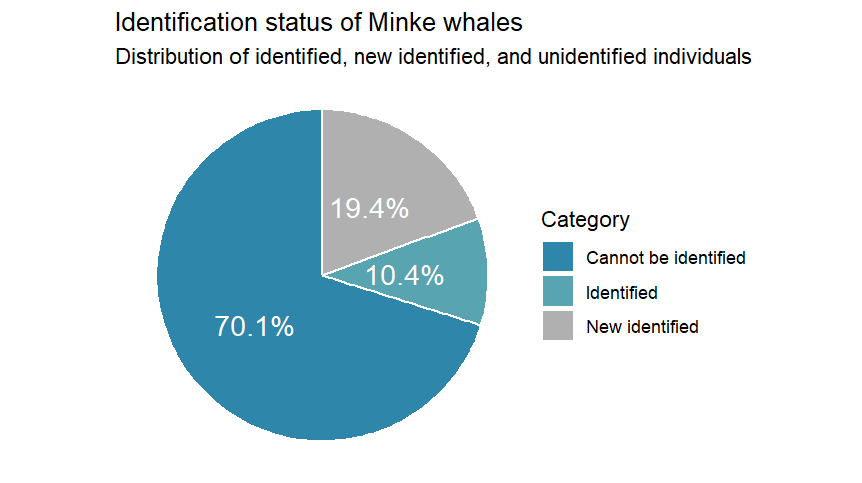
As you can see, it is much hard to identify minke whales.
Because whales are photographed and identified in different parts of the world, researchers can compare catalogues between regions. For example our photo catalogue is shared with Elding’s team in Akureyri allowing us to compare sightings across Iceland, track whales along different coast, and have a better understanding of their movements between Reykjavík and Akureyri.
Matching catalogues from different countries allowed scientist to identify migratory patterns, showing the incredible migration of those animals. Many of the humpback whales we see in Faxaflói bay during the summer, will migrate in the winter to warmer waters, their breeding grounds like Cape Verde Island and the Caribbean.
On of the longest match ever recorded was from a whale that was seen in the Pacific in Colombia in 2017. This individual appeared in the waters of Zanzibar in 2022, crossing two oceans!

How do we collect the photos ?
Photos are taken whenever the conditions allow. To ensure minimal disturbance, we never approach whales beyond safe distance, following the Ice-whale code of conduct.
Each photo is logged with a date, time, species, boat, creating a valuable record for later analysis. Once back on shore, the image are sorted, processed and saved in a hard drive.
Humpbacks whale identification is usually based on the fluke pattern:
• The contrast between black and white areas.
• The shape of the trailing edge (smooth, wavy, or jagged).
• The presence of distinctive scars or barnacles marks.
Minke whale identification is based on the dorsal fin and back:
• The shape and angle of the dorsal fin
• Small notches or scars along the edge
Each new photograph of a fluke of dorsal fin is compared to our catalogue of previously identified whales.
When a match is confirmed, the individual is added to the existing record, along with all new observations. If no match is found, the whale is assigned a new ID code and becomes part of the growing dataset.
Why is photo-ID important?
• Marks and scars are a description of the history of individuals. They can reveal anthropogenic threats, like collisions with boats, propeller injuries or entanglement scars. Teeth rakes can testify an interaction with orcas, their natural predator.
• Migration patterns: We learn where animals are migrating, between their breeding grounds and feeding grounds.
• Demographic analysis: With photo-identification data we can do some math and estimate the population, understand if the population is increasing or decreasing.
• Site fidelity: How attached are populations to certain areas, like Faxaflói, how often do the same individual come back to the same area.
Results for 2025
From january to october in Faxaflói Bay, a total of 82 individual humpback whales were identified with photo-ID. Of these, 42 new individuals not previously recorded in Elding catalogue. The remaining whales were familiar visitors, many returning from previous years.
For minke whales, 40 individuals were identified, including 26 new individuals that we could find in our catalogue. A lot of the minke whales pictures did not allow us to identify the individual, showing how challenging it can be to study those small baleen whales.
Looking ahead:
Elding photo-ID dataset continues to grow, giving us a better understanding of how humpback whales and minke whales use Icelandic waters. Long-term monitoring helps us detect changes in population size. An essential information for conservation in an era of changing oceans and human pressure. Each new photo taken during our whale watching tours bring new information to the long term record of Faxafliói biodiversity and gives us tool to preserve their habitat.
In the future, AI tools such as Happy Whale could play an roll in whale research. Helping to match humpbacks flukes and maybe even minke whale dorsal fins across global database.
Sven Dinant & Miquel Pons


Comments