
2025 sightings: one of our best years so far!
Last year was an extraordinary year for whale watching in Faxafloi Bay! We had many once-in-a-lifetime encounters, both for the passengers and crew. Two particular highlights of the year were the sudden explosion in bubble net feeding during the summer and a rare visit from a mother-calf pair for three and a half weeks in July! We saw plenty of our regular humpbacks, minkes, white-beaked dolphins and porpoises. We had a handful of sightings of orcas but we also had a couple of more unusual visitors - including 6 fin whales and 2 basking sharks!

As you can see in this graph, 2025 was our most successful year so far, with the fewest number of complimentary tours! We were blessed with plenty of fish in the bay last year, which brought plenty of cetaceans. Over the whole year, we only gave out complimentary tickets on 47 tours!
Humpback whales

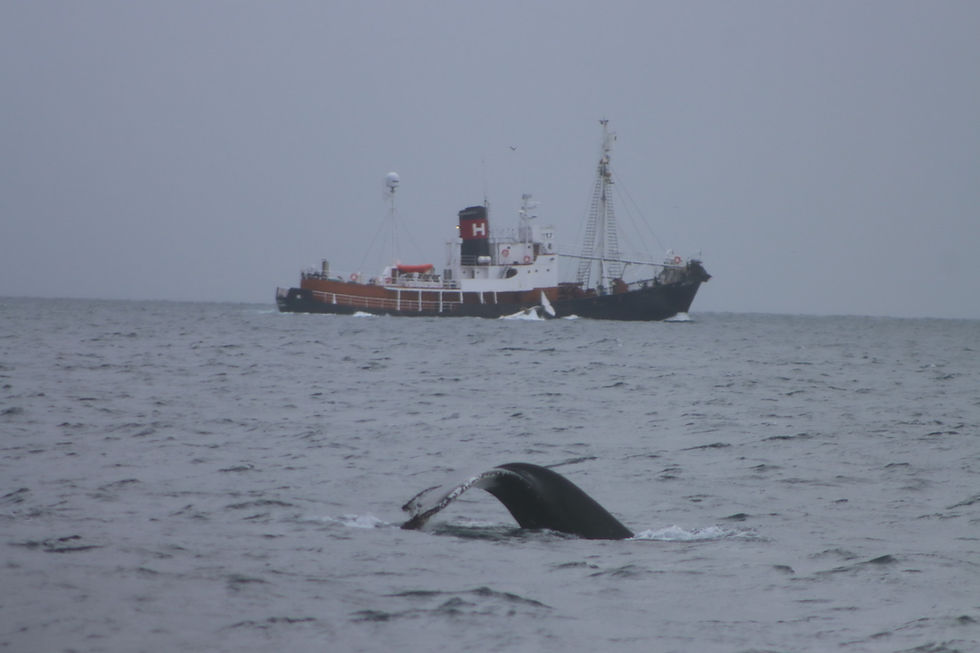
Humpback whales were our most commonly seen species last year. In 2025, we saw humpback whales on 85% of our tours! This is a 7% increase from 2024. We also saw a similar pattern to 2024, where in the winter we saw many humpbacks staying close to land. These residents allow for a more successful winter season. The summer of 2025 was noticeably more successful than that of 2024. You can see in this blog, 2024 summer sightings of humpback whales were particularly low in June (51%). Whereas in 2025, from June to August, we consistently had a success rate of over 90%!

Minke whales

Although the humpbacks were our main stars, the Faxaflói minke whales also had a banner year. Overall, this smaller whale is a bit more shy. However, last year we had a few very curious encounters with minkes circling the boats and inspecting the passengers! Over the whole of 2025, we saw minkes on 57% of tours, a 13% increase from 2024. This increase was especially significant in August with minkes seen on 67% more tours in 2025 than in 2024! Often, we see a pattern where in the months with more minke whale sightings, we see fewer humpbacks. However, this was not the case in 2025. Overall, both species of baleen whales followed a similar curve, with peak sightings in July and fewest at the beginning and end of the year.

White-beaked dolphins

White-beaked dolphins are often the most social of our cetacean encounters. They are mostly in pods of up to 15 individuals but in spring, they sometimes form super pods of hundreds of individuals. In 2025, we saw white-beaked dolphins on 38% of tours, only a 1% increase from 2024 and still a decline compared to 2023 where dolphins were seen of half of tours overall. With the increasing sightings of the larger humpbacks and minke whales, there might be some steep food competition for these smaller cetaceans. Despite the overall decrease in sightings, the graph below shows that we saw white-beaked dolphins further in the winter last year than in 2024. White-beaked dolphins were seen in both February and December in 2025 but were not seen at all in these months in 2024.

Harbour porpoises

Our last and shyest species is the harbour porpoise. As in previous years, we saw them through the whole year. In 2025, we saw them on 24% of tours, again only a 1% increase from 2024. In May, we saw porpoises on 38% of tours which was much higher than the last two years. May 2025 was when we found humpback whales in Hvalfjörður for the first time in 25 years. During these tours into the fjord, we also found many large pods of harbour porpoises!

Other than our four common species, we also had two unusual encounters with basking sharks in July 2025. Basking sharks are the second larges fish in the ocean, after the whale shark, and were historically seen in Faxaflói bay fairly frequently at the end of the summer. However, after 2019, no basking sharks were seen in the bay until last year! Unfortunately, basking sharks are globally endangered due to historic overfishing. Hopefully these sightings last year mean that the sharks are slowly returning to the bay and we might see more of them in the future!
We always love getting out on the water to see and document the animals our variety of cetaceans. Here’s hoping 2026 will be another fantastic year full of wonderful encounters. Maybe you will come along for a cruise too!
Emily Erskine


Comments